Published:
The IPTV World in 2026 — How Streaming Took Over Television Globally
The IPTV world in 2026: a $100B+ global market, fragmented sports rights, a worldwide piracy crackdown with subscriber fines, and how to stay on the legal side.

The IPTV world in 2026 is the global shift of television from cable and satellite to the open internet — and it is now the mainstream way the planet watches TV. Internet Protocol Television delivers live channels, films, and series as IP packets over your broadband, and the worldwide market has already passed $100 billion, on its way to roughly $133 billion by 2030. Three forces define the IPTV world this year: explosive growth driven by cord-cutters who follow live sport, the fragmentation of sports rights across a dozen apps, and a coordinated international crackdown on pirate IPTV ahead of the 2026 FIFA World Cup that is now fining end users, not just sellers. This guide maps the entire IPTV world for 2026 — the numbers, the players, the legality map by region, the technology, and exactly how to stay on the safe, legal side of it.
Quick summary — the IPTV world in 2026
- Market size: ~$56B in 2025 → ~$133B by 2030, about 18.7% annual growth.
- The driver: ~68% of cord-cutters switch for live sport as rights scatter across NBA, NFL, Premier League and World Cup deals.
- The crackdown: real-time stream blocking, "Operation Switch Off", and subscriber fines — France up to €400, Greece up to €5,000, Italy 2,200+ users fined.
- The technology: 4K/8K, HEVC (H.265) compression, AI recommendations, sub-second channel switching.
- The takeaway: the IPTV world is legal as a technology — only the provider and content decide legality. Choose a licensed service with a free trial.
In this guide we cover what the IPTV world actually is in 2026, the market numbers and what powers them, why live sport broke traditional TV, a region-by-region legality map, the worldwide enforcement wave and what it means for ordinary viewers, the technology redefining streaming, where the Nordic region and Sweden fit, and a practical framework for choosing a legal service. Everything is grounded in current 2026 market reporting and our own testing across twelve device types.
What the "IPTV world" means in 2026
The IPTV world is the worldwide ecosystem of services, devices, apps, and viewers that deliver and consume television over the internet rather than cable, satellite, or a terrestrial aerial. In 2026 that ecosystem is no longer a niche — it spans legal subscription providers, the broadcasters' own streaming apps, and an unfortunately large pirate underground, all running on the same underlying IP technology.
What unifies the entire IPTV world technically is simple: channels and video are converted into digital IP packets, sent over broadband, and reassembled by an app on your screen in real time. The same protocols — M3U/M3U8 playlists, the Xtream Codes API, and XMLTV electronic programme guides — power a legal Nordic service, a global streaming giant, and a pirate reseller alike. That is exactly why the legality question matters so much: the technology is neutral, so the line between legal and illegal is drawn entirely by licensing, not by the protocol. For the fundamentals of how the technology works, see our explainer on what IPTV is and how it works, or follow the full signal chain in our breakdown of how IPTV actually works.
The numbers: how big the IPTV world got
The IPTV world reached roughly $56.6 billion in value in 2025 and is projected to grow to about $133 billion by 2030 — a compound annual growth rate near 18.7%. In the same window traditional cable continued its long decline, and global IPTV revenue pushed past the $100 billion mark, confirming that internet-delivered television is now the centre of gravity, not the alternative.
Behind the headline figure are a few hard drivers worth understanding:
- Cord-cutting at scale. Roughly 68% of people who cut the cord in 2026 cite live sports as their primary reason for switching — the single biggest engine of the IPTV world.
- Broadband ubiquity. In high-connectivity regions like the Nordics, over 90% of households have speeds comfortably above the IPTV threshold, removing the last technical barrier.
- Device saturation. Almost every TV sold today is a smart TV (Samsung Tizen, LG webOS, Sony Bravia), and Fire TV Stick, Apple TV, and Android TV boxes put IPTV one app away in hundreds of millions of homes.
- Price pressure. A legal IPTV subscription costs a fraction of a legacy cable package, and the gap is widening every year.
The result is a self-reinforcing cycle: more viewers attract more content, which attracts more viewers. The IPTV world in 2026 is mainstream television.
No commitment · no credit card
Why live sport broke traditional TV
The single biggest force reshaping the IPTV world is the fragmentation of sports rights. In 2026 watching the sport you love requires more subscriptions than ever, because leagues have split their broadcasts across competing platforms to maximise revenue — and viewers are voting with their wallets for services that put it all back in one place.
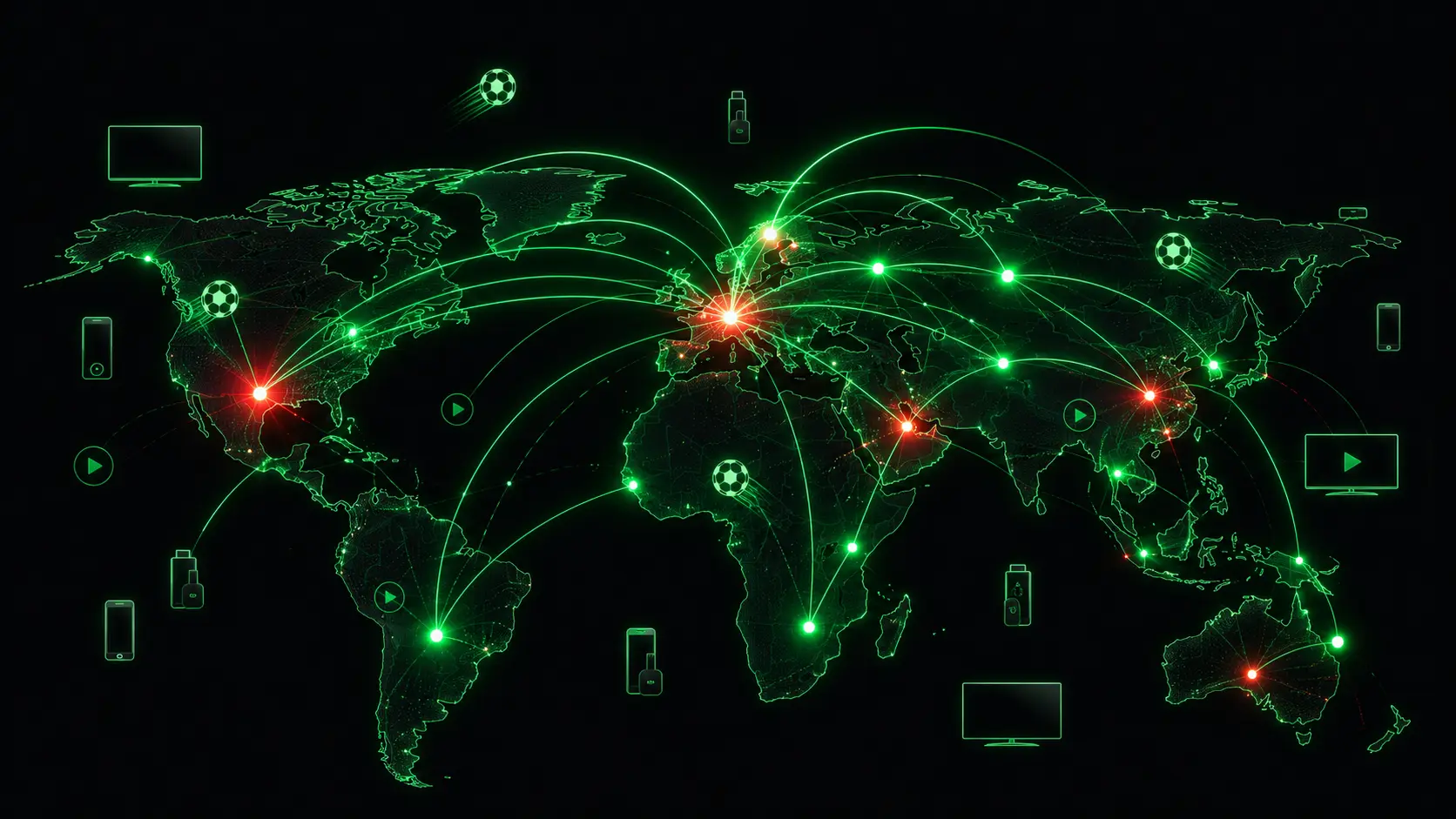
The fragmentation is now extreme. The NBA signed a historic media deal worth around $76 billion that redistributed games across Amazon Prime Video, NBC's Peacock, and ESPN platforms from mid-2026. NFL games are scattered across NFL+, Peacock, Amazon Prime, ESPN+, YouTube TV, and traditional networks. In Europe, the Premier League, Champions League, and domestic leagues like Sweden's Allsvenskan and the SHL hockey league each sit behind different broadcasters and apps. A fan who simply wants to watch their teams now faces a confusing, expensive maze of overlapping services. Our focused guide to IPTV sports for Allsvenskan, SHL and the Champions League shows how to collapse that maze back into a single subscription.
This is precisely the gap a complete IPTV service fills: a single subscription that consolidates the channels carrying those competitions, with one app, one login, and one EPG. It is also why the World Cup — the most-watched event on earth — has become the flashpoint of the entire IPTV world in 2026.
The IPTV world legality map by region
Across the IPTV world the same rule applies everywhere: the technology is legal, but using an unlicensed service that redistributes content without rights is not. What differs by region is enforcement intensity, and in 2026 that intensity is rising fast almost everywhere.
| Region | Legal landscape in 2026 | Enforcement trend |
|---|---|---|
| Nordics (Sweden, etc.) | Legal providers licensed; new Swedish law from 1 July 2026 | Rising — consumer liability introduced |
| UK & Ireland | Legal services; Premier League "piracy shield" active | High — real-time blocking during matches |
| Italy | Strong legal market; "Piracy Shield" system | Very high — thousands of subscribers fined |
| France | Legal services widespread | High — subscribers fined after reseller busts |
| Spain & Germany | Mature legal markets | Rising ahead of the World Cup |
| Greece | Legal providers | High — subscriber fines €750–€5,000 |
| US & Canada | Legal IPTV plus broadcaster apps | Rising — coordinated takedowns |
The pattern is unmistakable: the legal IPTV world is growing and consolidating, while the pirate corner is being squeezed from every direction. For viewers, the practical implication is that choosing a licensed provider is no longer just an ethical choice — it is the only choice that guarantees your service will still be working next month.
Activated within 5 minutes
The 2026 worldwide crackdown — and what it means for you
The biggest news in the IPTV world this year is a coordinated, international crackdown on pirate IPTV in the build-up to the 2026 FIFA World Cup. The tournament is set to be one of the most heavily protected broadcasts in history, and enforcement has shifted from chasing operators slowly to blocking streams in real time and fining ordinary subscribers.
The enforcement tactics have changed fundamentally. Courts in several countries now authorise real-time blocking of illegal streams during live matches, forcing internet providers to cut access within minutes of a pirate feed being identified — so an entire pirate network can vanish mid-match. The UK's Premier League "piracy shield" and Italy's equivalent system are the templates other countries are adopting.
The operations have been large and global:
- Operation Switch Off (early 2026) took major illegal IPTV platforms offline across multiple countries.
- A coordinated action involving Italy, Romania, Spain, the UK, Canada, Kosovo, and South Korea dismantled a network serving millions, seizing well-known pirate brands and blocking over 125,000 end users in Italy alone.
- App-store purges removed dozens of pirate IPTV apps with tens of millions of downloads around major tournaments.
Most importantly for ordinary viewers, the fines are now hitting subscribers, not just sellers. France fined pirate IPTV subscribers up to €400 each after a reseller bust exposed their details; Italy has fined thousands of users; and Greece introduced fines from €750 up to €5,000. Independent piracy-news outlet TorrentFreak has documented case after case through 2025–2026. The takeaway is blunt: in 2026 a cheap pirate subscription is a financial and legal risk, not a bargain. A legal service like Nordisc IPTV removes that risk entirely.
The technology redefining the IPTV world
Beyond the headlines, the IPTV world is being reshaped by genuine technical progress that makes legal services better than the cable they replaced. The standout developments in 2026 are:
- 4K and early 8K — premium channels now stream in 4K Ultra HD with HDR10 and Dolby Vision, and 8K beta tests are appearing on the highest-end services.
- HEVC (H.265) compression — more efficient encoding delivers the same picture at lower bitrates, so 4K is viable on ordinary home broadband.
- AI-powered recommendations — services increasingly surface channels and VOD based on viewing habits, much like the big streamers.
- Sub-second channel switching — the best providers switch channels in 0.3–0.5 seconds, eliminating the lag that plagued early IPTV.
- Low-latency live sport — critical for following matches in real time, and a key differentiator we measure in our own testing.
- Smart-home and multi-device — voice control and seamless handoff between TV, phone, and tablet are now standard expectations.
The practical upshot: a well-built legal IPTV service in 2026 doesn't just match cable, it beats it on quality, breadth, and flexibility. If you want help picking the right playback app to take advantage of all this, see our guide to the best IPTV smart players.
Beyond live sport — the rest of the IPTV world
Live sport grabs the headlines, but the IPTV world in 2026 is just as much an on-demand and international-channel ecosystem. A complete legal service pairs its live channels with several things the old cable model never offered at this scale:
- Vast VOD libraries. Modern providers carry 50,000+ on-demand films and series, refreshed continuously — the box-set convenience of the big streamers, bundled with live TV rather than sold as yet another separate subscription.
- Catch-up and time-shift. Missed a match or a show because of your time zone? Catch-up TV lets you rewind the last few days on most channels, so the schedule bends around your life instead of the other way around. For anyone watching across time zones, this is one of the most-used features in the whole IPTV world.
- International and diaspora channels. This is one of the IPTV world's quiet superpowers. A single service can carry Swedish channels like SVT and Barnkanalen alongside Arabic, Turkish, Polish, and dozens of other national line-ups — invaluable for the hundreds of millions of people living outside their home country and impossible to replicate with the broadcasters' own region-locked apps.
- Always-on news and niche channels. From 24-hour global news networks to hobby, music, and regional channels that never earned a slot on cable, the long tail of the IPTV world is enormous — and it costs nothing extra to carry on an internet feed.
Add multi-language audio tracks, subtitles, and an EPG that spans every channel, and the picture is clear: the IPTV world is not just a cheaper way to watch the same television — it is a fundamentally broader one. For households that mix languages, follow more than one country's media, or simply want everything in a single app, that breadth is the real reason internet TV has won. It is also why a well-curated legal provider — rather than the biggest possible channel count from an anonymous source — is what actually delivers a good day-to-day experience. A bloated pirate list of 100,000 dead links is worth far less than a curated, reliable lineup you can actually watch on a Tuesday night.
Support team available 24/7
Where the Nordic region and Sweden fit in the IPTV world
The Nordic region is one of the most advanced corners of the IPTV world, thanks to near-universal high-speed broadband and an early cord-cutting culture. Sweden in particular is a mature, fast-growing market — and from 1 July 2026 a new Swedish law makes it an offence even for consumers to use illegal IPTV services, mirroring the wider European enforcement trend.
For Swedes — at home and especially abroad — this matters in two ways. First, it makes choosing a transparent, licensed provider essential rather than optional. Second, it underscores the value of a Nordic-focused legal service that carries SVT, TV4, Allsvenskan, SHL, and the major European football competitions in one place, with an EPG locked to Swedish CET/CEST time. If you live outside Sweden, our Swedish IPTV abroad guide covers exactly how to access home channels legally from another country, and our best rated IPTV Sweden methodology gives you a measurable way to score any provider.
How to choose a legal service in the 2026 IPTV world
Navigating the IPTV world safely comes down to recognising a legitimate provider in a market crowded with risky offers. Score any candidate on these criteria before you pay:
- Licensing and transparency — a real company with a verifiable address and published pricing, not an anonymous Telegram seller demanding crypto.
- A genuine free trial — legitimate services let you test before paying; "pay six months upfront, no trial" is a red flag.
- Channel completeness — does it carry the channels and leagues you actually watch, in one subscription?
- Picture quality — HD and 4K included without surcharges, with sub-second channel switching.
- Open standards — M3U/Xtream Codes you can use in IPTV Smarters Pro or TiviMate, never a locked vendor app.
- Uptime during live sport — 99.9% on big match nights is the minimum; read independent reviews.
- Reachable support — a human on WhatsApp and email, across time zones.
Here is how the main options in the IPTV world compare for an ordinary household:
| Legal IPTV (Nordic-focused) | Pirate IPTV | Cable/Satellite | Big streamers (Netflix etc.) | |
|---|---|---|---|---|
| Legal & safe in 2026 | Yes | No — fines & shutdowns | Yes | Yes |
| Live channels + sport | Yes, consolidated | Yes, until shut down | Yes | Limited |
| One subscription | Yes | Yes | No | No (several needed) |
| 4K / reliability | High | Unreliable | Medium | High |
| Monthly cost | From ~€7 | "Cheap" but risky | High | Adds up across services |
| Free trial | Yes | No | Rarely | Sometimes |
The comparison makes the safe path obvious: a licensed IPTV service gives you the consolidation and price of the pirate option without the legal and reliability risk. Want the full provider ranking? See our best IPTV 2026 guide.
Start streaming in 5 minutes
Staying safe in the IPTV world — a practical checklist
Even with good intentions it's easy to stumble into the risky side of the IPTV world. Use this troubleshooting and safety checklist to keep yourself on the legal, reliable side:
- The price is impossibly low. A service offering "every channel on earth" for a few euros a year is almost certainly unlicensed. Real licensing costs money; sustainable legal services price accordingly.
- No company, no trial, crypto-only. If you can't find a registered business, there's no free trial, and they only accept cryptocurrency or gift cards, walk away.
- Telegram-only contact. Legitimate providers offer traceable support on WhatsApp and email. A Telegram-only operation is built to disappear.
- Streams die during big matches. If a service collapses every time there's a major game, you're likely on a pirate feed being blocked in real time — the opposite of what you paid for.
- "Link expired" with no notice. Legal providers proactively notify you and reissue links; pirate services vanish without warning.
- Test before committing. Always use a free trial to verify channel quality, the EPG, and stability on your own connection before paying for a longer term.
The single best protection in the 2026 IPTV world is simple: choose a transparent provider with a free trial, and never pay a long term upfront to a service you can't verify.
FAQ — The IPTV world in 2026
What is the IPTV world and is it legal?
The IPTV world is the global ecosystem of internet-delivered television — providers, apps, devices, and viewers. The technology itself is completely legal. What determines legality is whether a given service is licensed for the content it distributes. Licensed providers are legal; unlicensed pirate services are not, and in 2026 using them carries fines in many countries.
How big is the global IPTV market in 2026?
The IPTV market was worth roughly $56.6 billion in 2025 and is projected to reach about $133 billion by 2030, growing near 18.7% per year. Global IPTV revenue has already passed $100 billion, while traditional cable continues to decline.
Why is there an IPTV crackdown before the 2026 World Cup?
The FIFA World Cup is the most-watched event on earth, so rights holders and authorities protect it heavily. Ahead of the 2026 tournament, countries are using real-time stream blocking and coordinated takedowns, and several are fining subscribers — not just sellers — of pirate IPTV services.
Can I get fined for using illegal IPTV?
Yes, in a growing number of countries. France has fined subscribers up to €400, Greece introduced fines from €750 to €5,000, and Italy has fined thousands of users. From 1 July 2026, Sweden's new law also makes consumer use of illegal IPTV an offence. Using a licensed service avoids this risk entirely.
What internet speed do I need for IPTV?
For HD, about 25 Mbps is enough; for 4K, allow at least 50 Mbps per stream; and 100 Mbps if several devices stream at once. HEVC (H.265) compression in 2026 makes 4K viable on ordinary home broadband. A wired connection is best for 4K.
How do I tell a legal IPTV service from a pirate one?
A legal service is a registered company with published pricing, a genuine free trial, traceable WhatsApp/email support, and open-standard logins (M3U/Xtream Codes). Pirate services are typically anonymous, crypto- or gift-card only, Telegram-only, with no trial — and they collapse during big matches as they're blocked in real time.
Does IPTV replace Netflix and cable?
It can replace cable outright and often complements the big streamers. A complete IPTV service delivers live channels and sport that Netflix doesn't, plus a large VOD library. For sports fans facing fragmented rights, one legal IPTV subscription frequently replaces several services at once.
Summary — the IPTV world in 2026
The IPTV world in 2026 is mainstream global television: a $100B+ market growing toward $133 billion, powered by cord-cutters chasing live sport across an increasingly fragmented rights landscape, advanced by 4K/8K and HEVC technology — and policed harder than ever by a worldwide crackdown that now fines subscribers, not just sellers. The defining choice for any viewer is no longer cable versus internet; it's legal versus illegal.
The safe path is straightforward: choose a transparent, licensed provider with a genuine free trial. We recommend testing Nordisc IPTV — a legal Nordic-focused platform with 20,000+ channels, 4K quality, a Swedish-time EPG, and no contract. Check the current plans and pricing to see how it fits your household and claim a safe place in the modern IPTV world.
Nordisc IPTV is a legal, Nordic-focused IPTV provider with a focus on quality, stability, and English- and Swedish-speaking support across European and US time zones. We help households worldwide watch the channels they love — safely and legally.